

"Goose or duck down?" is a question that decides your sleeping comfort for years. Both fillings are natural, light and very warm, but they differ in loft, durability, potential odour, availability and price.
Goose down usually has a higher fill power and keeps its loft longer, so for the same warmth class the duvet can be lighter, warmer and more durable. Duck down tends to be cheaper and more widely available; in higher grades (for example 90/10 with good fill power) it gives very good comfort at a sensible price, though a new product may carry a greater risk of a natural odour. The decision should rest on: the proportion of down (e.g. 90/10 vs 70/30), loft (the higher the cuin, the better), weight and warmth class (summer, all-year, winter), the quality of the casing (downproof, densely woven cotton), the baffle construction, and ethical and quality certificates. For people who feel the cold and for cool bedrooms, goose down has the advantage of lightness with high warmth. For a budget and everyday use in moderate conditions, duck down with good parameters will be optimal. The key is the specification, not the name of the filling.
Contents: |

1. Definitions and differences
Down consists of the soft, three-dimensional clusters beneath a bird's feathers. They form a network of air pockets that insulate and store heat. Feathers have a visible quill, are heavier and less springy. When you ask "goose or duck down", you are asking about the source of those clusters. Goose down statistically reaches a higher fill power, which is why for the same warmth class it needs fewer grams of filling, giving a lighter, "fluffier" duvet. Duck down is more common and usually cheaper, though top batches can come close to goose in their parameters. The price difference follows from raw-material availability and quality selection. The smell of a new duvet is more often attributed to the duck fraction, though proper washing, dust removal and drying limits this effect in duck-sourced products too. In the end it is not the name that determines comfort but the sum: the proportion of down, the loft, the baffle construction and a casing that stops the filling migrating.
2. Criteria for judging quality
The most important parameter is loft, known as fill power (cuin). The higher it is, the more air a given gram of down traps, so the duvet will be lighter for the same warmth. The second element is the down/feather ratio: 90/10 means 90% down and 10% feather, which usually translates into higher comfort and less weight than 70/30. The weight does not "have to" be high if the fill power is solid. The casing matters too: densely woven, downproof cotton that blocks feathers from working their way through and limits heat loss. Baffle construction stops the filling moving about, keeping the warmth even. The quality of down cleaning (dust removal, washing, drying) affects odour and hygiene. Ethical and quality certificates (for example responsible sourcing of the raw material) make the purchase more transparent. A guarantee and access to servicing (topping up, re-proofing) extend the product's real life and lower the cost over time.
3. Comparison table: goose vs duck down
Goose down: usually higher fill power, longer-lasting loft, lower duvet weight for the same warmth class. Often more expensive, selected, seen as "premium". Duck down: a better price, wide availability, good performance in the middle grades; top batches can bring comfort close to goose, though statistically it falls behind in loft and may a little more often betray the natural odour of a new product. The decision is also affected by casing and construction: even the best down will lose its potential in a poor material or without baffles. Price is not an unambiguous indicator of quality. Look for hard data: the exact proportion of down, the loft, the weight, a description of the quilting, the certificates. If a seller states only "down", with no numbers, treat that as a warning sign. In the end, judge the pair: down + casing + construction. That set determines warmth, lightness and durability, not the answer to "goose or duck down" on its own.
4. How to match a duvet to your needs
If you often feel cold and sleep in a cool bedroom (around 16–18°C), choose a winter duvet or a warm all-year one with high-loft goose down. It will give plenty of warmth at low weight. If you overheat easily, a light all-year duvet with high fill power is better – it warms without weighing you down. Allergy sufferers are served by down that is well de-dusted and properly washed; a dense casing, regular airing and drying matter too. If price counts, consider duck down 90/10 in a good casing – the comfort will be high and the cost lower.
Looking for a "hotel" effect? Go for lightness, even baffles and loft; goose down usually wins here, though carefully chosen duck down gives very similar impressions. Always match the warmth class to the room temperature and your own thermal profile. The parameters matter: the proportion of down, the loft, the weight and the baffle construction together determine comfort.
5. Down/feather blends and warmth classes
The proportions of down and feather affect the weight and the "fluffiness" of the duvet. A 90/10 blend (90% down, 10% feather) is lighter and springier for the same amount of warmth. A 70/30 blend usually costs less but is heavier and gives a less "cloud-like" feeling, though it still warms well.
Match the warmth class to the bedroom temperature and to your own thermal profile. A summer duvet has the least filling and suits rooms above 20–22°C. An all-year duvet is a safe middle ground for stable conditions in a flat. A winter duvet has more filling and holds warmth better in cool rooms.
Do not look only at the number of grams. What counts is the loft of the down (fill power). The higher it is, the lighter the same duvet is while still being warm. A model with high loft can therefore warm as well as a heavier but less lofty one.
Pay attention to the baffle construction. Closed baffles keep the filling in place and limit "cold spots", so the warmth is distributed evenly. If you often feel cold during the day but overheat easily at night, choose an all-year duvet with higher loft. You will get a good amount of warmth without unnecessary weight and better regulation in different conditions.
6. Quality in an online store: what to look at
Does the description clearly say "goose or duck down" and give the proportion of down (e.g. 90/10)? Is there a real fill power, rather than a generality such as "very springy"? Check the weight and warmth class, the type of casing (densely woven, downproof cotton), the baffle construction and the way it is quilted. Look for information about the cleaning, washing and drying of the down. Ethical and quality certificates should be given with the name of the standard, not just the slogan "certified quality". In descriptions, avoid marketing promises without figures. A reliable seller shows the parameters and explains what they mean. If the specification is incomplete, ask for specifics: the proportion of down, the cuin, the weight, the type of casing and the baffle layout. Only then compare prices.
7. Care and durability
Air the duvet regularly, ideally out of harsh sunlight. Use a densely woven cover to limit soiling and feather migration. Wash only in line with the label: a large machine, a gentle programme, a mild detergent, thorough rinsing. Tumble drying with balls (wool ones, for example) restores the loft, breaks up clumps and shortens the time it stays damp, which limits odour. Avoid storing it in compression bags for long periods – down needs volume to keep its loft. Remove stains promptly and spot-wise, and before putting it away for the season make sure the duvet is completely dry. If it loses loft after some years, consider professional regeneration (cleaning and topping up the down) rather than immediate replacement. Such maintenance extends the life of the duvet and lowers the cost per year of use. Good care evens out the differences between goose and duck in practical, long-term comfort.
8. Drawbacks and an alternative
Natural down has its limits. A higher price for top parameters. Sensitivity to moisture and a risk of clumping if the duvet gets damp. It calls for careful maintenance: airing, tumble drying with balls, avoiding long compression. A potential "new" odour after unpacking. Individual feathers may work through without a downproof casing. It does not like frequent washing. Allergy sufferers may react to residual dust or micro-particles if the down has not been perfectly de-dusted.
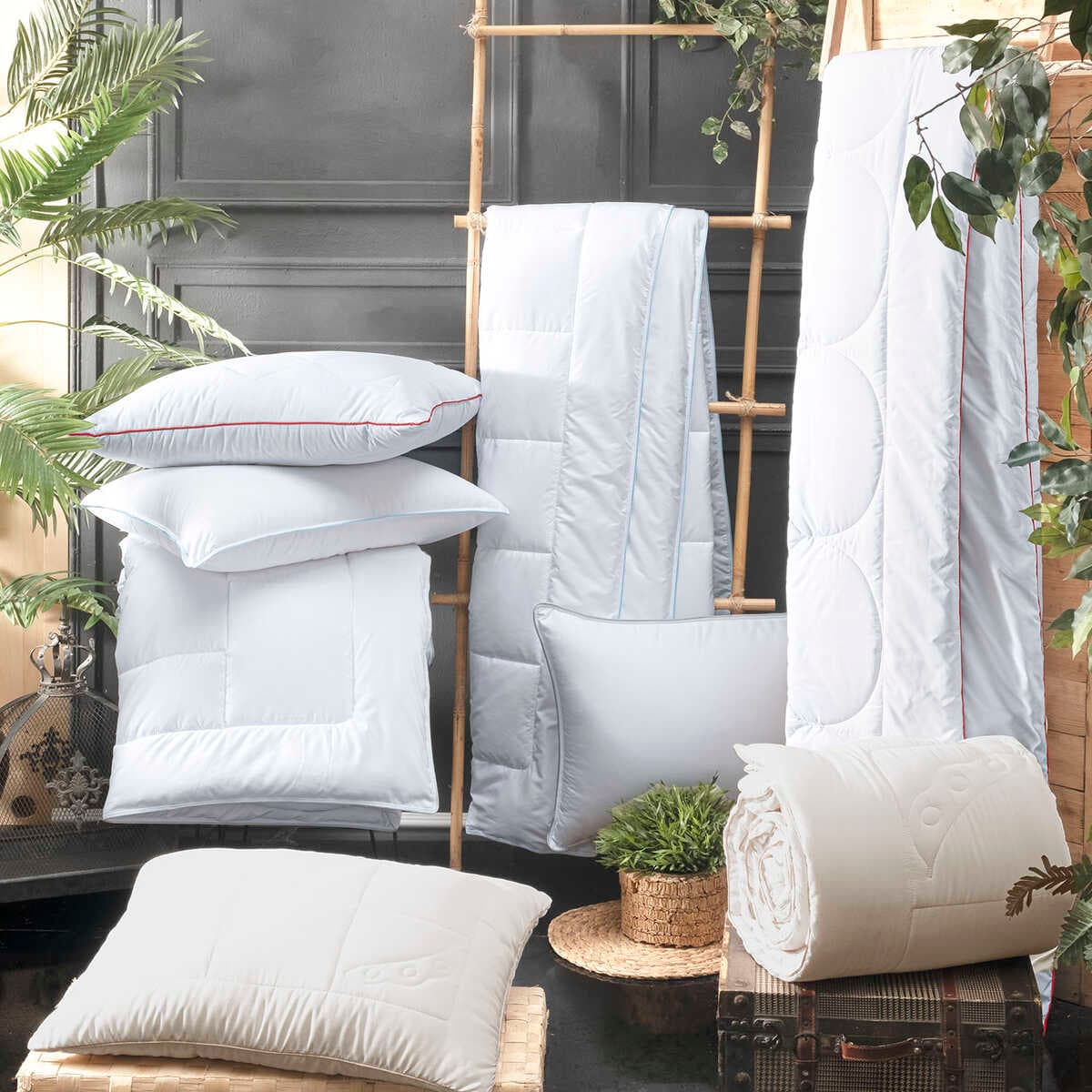
If any of these drawbacks apply to you, consider a synthetic alternative. Our duvets and pillows with silicone/hollow-fibre filling are hypoallergenic, easy to wash, dry quickly and cope better with moisture. They keep a stable warmth at lower packed weight and lower purchase cost. They work well in flats with variable temperature, with frequent washing, in children's rooms and in rental properties. See our selection of synthetic duvets and choose a model matched to your bedroom temperature and your tolerance for allergens.
Pillows and duvets with synthetic filling